
When automotive engineers evaluate advanced high-strength steel (AHSS), the standard tensile test only tells part of the story. A new article from AHSS Insights, contributed by Trey Leonard of Standard Mechanics, LLC and Danny Schaeffler of Engineering Quality Solutions, explains why crash performance depends on understanding how steel behaves at strain rates far beyond those used in conventional testing. During a real collision, body structure components like B-pillars, rocker reinforcements, and crash rails deform at rates several orders of magnitude faster than quasi-static testing captures, meaning standard yield and tensile strength values alone can’t predict how a part will actually perform.
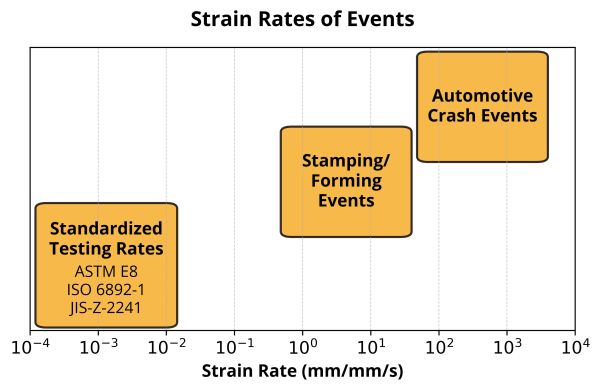
The article walks through how this dynamic behavior gets translated into usable engineering data. Most automotive steels grow stronger as loading speed increases, but the degree of that effect varies by grade, so OEMs and suppliers generate stress-strain curves across multiple strain rate regimes to calibrate models like Cowper-Symonds and Johnson-Cook for crash simulation software such as LS-DYNA and Abaqus. Generating that data requires different testing equipment depending on the rate of interest, from modified servo-hydraulic systems for intermediate rates to split Hopkinson bar setups for true crash-level speeds, along with digital image correlation to map strain localization across specimen geometries.
The piece also highlights some of the practical hurdles in this work, including stress wave propagation and “load ringing” that can distort results from thin sheet specimens, and the lab-to-lab variability that persists even with standards like ISO 26203 in place. The takeaway: high strain rate testing isn’t an academic exercise, but a foundational input for designing lighter, safer vehicle structures with simulation models engineers can actually trust.
Read the full article on AHSS Insights: High Strain Rate Testing of Advanced High-Strength Steels.