
The B-pillar is one of the most demanding components in a vehicle body structure. It has to be strong enough at the top to protect the passenger cabin in a side impact, while the lower section must absorb crash energy—two very different performance requirements in a single stamped part. Meeting both used to mean press hardening was the only viable path. Now, engineers have a compelling cold-stamping alternative.
Third generation advanced high-strength steels are engineered to combine the best of dual-phase and complex-phase grades, delivering the formability needed for deep draws and complex geometries alongside the edge-stretch performance that prevents cracking at shear-cut edges. In real production applications—from the Chevrolet Blazer EV to the Toyota bZ4X—these grades are already proving their value in B-pillars and door rings, achieving stringent crash targets with greater manufacturing flexibility.
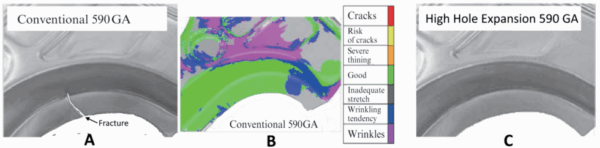
B-Pillar Upper stamped from 590 GA (a conventional galvannealed steel with 590 MPa minimum tensile strength, shown in A) and HHE 590 GA (a steel with 590 MPa minimum tensile strength engineered for high hole expansion, shown in C). The simulation of the conventional 590 GA does not indicate forming issues, as shown in image B.
The engineering decisions behind those applications are documented in full, with case studies showing how grade selection solved specific stamping challenges on the production floor. If you’re looking for practical, data-backed guidance on aligning steel selection to part requirements, this is where to start.
Read the full article: https://ahssinsights.org/news/case-studies-in-ahss-alloy-selection/